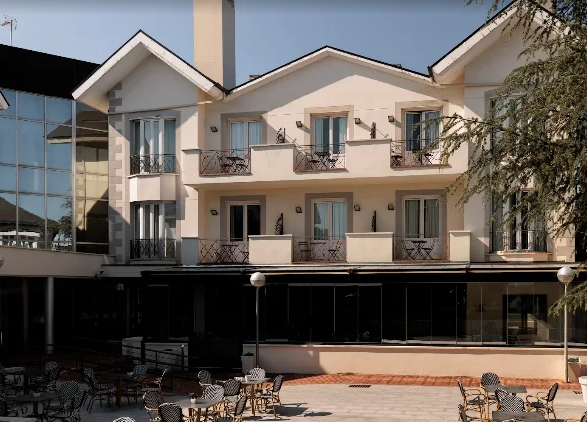
If you’re looking for a charming hotel in Pravia that surprises you with its history and not just its decor, PAX Casona del Busto has a head start: here you sleep inside a 16th-century palatial manor house, in the historic centre of the town that was once the capital of the Kingdom of Asturias.
PAX Casona del Busto is a hotel in Pravia set inside a 16th-century palatial manor house, on Calle del Rey Don Silo, next to the Town Hall. It has 30 rooms, is 13 kilometres from Asturias Airport, and has Cudillero, Avilés and Oviedo less than 30 minutes away by car. Ready to discover all its charm?
Key points
- Casona del Busto is a 16th-century palatial manor house located right in the historic centre of Pravia, in the Bajo Nalón area.
- Pravia was the capital of the Kingdom of Asturias between 774 and 792, when King Silo moved the court from Cangas de Onís.
- The church of Santianes de Pravia, about 4 kilometres from the hotel, is the oldest pre-Romanesque building in Asturias and was declared a Site of Cultural Interest in 1931.
- The hotel has 30 rooms across double, deluxe, family, superior family and junior suite categories, spread between the main building and two annexes around an interior courtyard.
- From Pravia you can reach Cudillero, Avilés and Oviedo in under 30 minutes, making the town a logistics base for exploring western and central Asturias.
- Pravia’s historic-artistic ensemble was declared a Site of Cultural Interest in 1995 and includes the Collegiate Church of Santa María la Mayor, the Town Hall and several 17th- and 18th-century palaces.
What sets Casona del Busto apart from a rustic country stay
A charming hotel in Pravia like PAX Casona del Busto differs from a rustic country stay in one specific way: the building itself is the heritage. The difference isn’t in exposed stone or wooden decor, but in the fact that the property has documented history.
The distinction matters because the term Asturian casona (manor house) is used with two very different meanings. On one hand, it refers to genuine 16th- to 18th-century noble buildings, with a main floor, courtyard and chapel. On the other, it’s applied to recent constructions that imitate that style with exposed stone and wood. In the case of Casona del Busto, the building is a documented 16th-century palatial manor house. The hotel opened as a hotel business in 1993, after a thorough restoration of the property.

What remains of the original 16th-century building
The restoration of the manor house preserved three distinct historical layers, all visible today. It’s the detail that most surprises anyone booking expecting a themed-decor hotel:
- A 16th-century rope-and-mortar partition wall, glazed and visible on the main floor of the building.
- Beam and shutter woodwork in peacock blue, the characteristic colour of 18th-century Asturian manor houses.
- 19th-century skirting tiles, combined with ochre-toned walls in the entrance area.
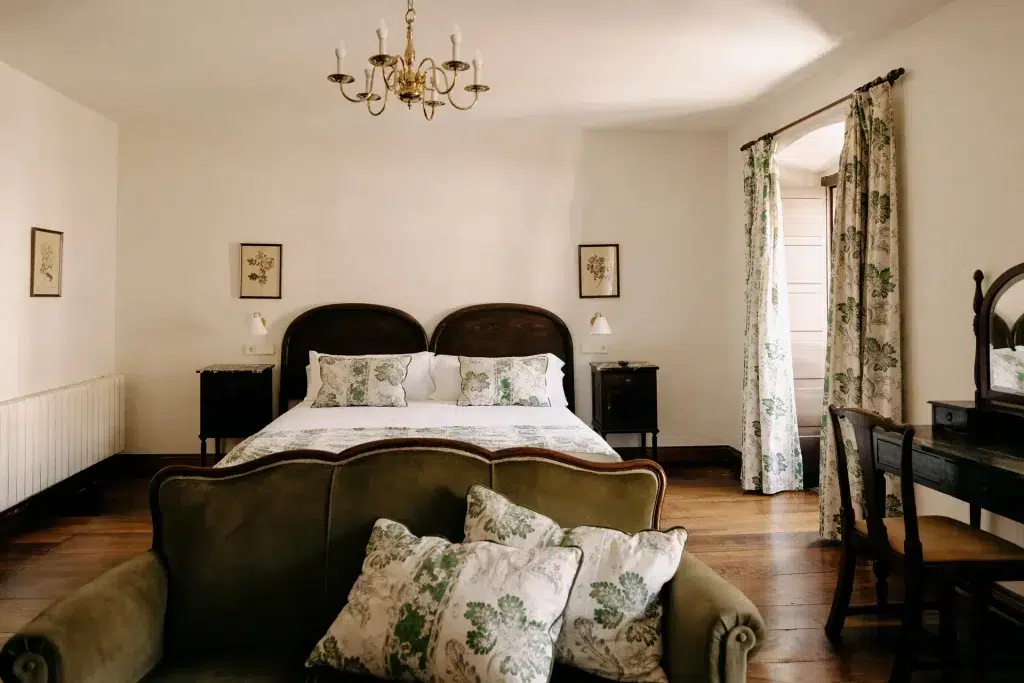
The 30 rooms are split between the main building and two later annexes. Twelve of them are arranged around the interior courtyard, which also serves as the breakfast area. The floors are chestnut wood parquet, and much of the furniture comes from antique dealers and auctions.
The property includes a courtyard, chapel and meeting rooms, plus a billiards room and outdoor spaces. It’s an unusual set-up for a three-star hotel, which explains why the property is frequently classified as a boutique hotel rather than a stopover hotel.
Gaspar Melchor de Jovellanos, an Enlightenment figure from Gijón and Minister of Grace and Justice, left written accounts of his stays at Casa del Busto during his travels through Asturias.
Pravia, the town that was capital of the Kingdom of Asturias
Pravia was the capital of the Kingdom of Asturias between the years 774 and 792. King Silo, married to Queen Adosinda —daughter of Alfonso I and granddaughter of Pelayo—, moved the court from Cangas de Onís to the ancient Roman Flavium Avia, a more central position within a kingdom that already included Galicia.
The municipality now has 7,792 residents, according to the official 2025 population figure from Spain’s National Statistics Institute (INE), and borders Cudillero, Muros del Nalón, Candamo, Soto del Barco and Salas.
Santianes de Pravia, the oldest pre-Romanesque church in Asturias
The church of San Juan Apóstol y Evangelista de Santianes is the oldest pre-Romanesque monument in Asturias. It was commissioned by King Silo and Queen Adosinda around the year 780, conceived as a palatine church and royal pantheon, as detailed by Turismo Asturias’ page on Santianes de Pravia.
The building retained its original form until the 16th century and underwent major changes in the 17th and 19th centuries; restoration work to recover its original shape began in 1970. It was declared a Site of Cultural Interest in 1931.
A short walk from the church is the Santianes Pre-Romanesque Museum, with archaeological pieces, models and an audiovisual presentation about King Silo’s court. Up-to-date opening hours and prices are available on the Pravia Town Hall tourism website.
A lesser-known fact: Santianes was the setting for the first episode of the theological Adoptionism dispute. It was there that Beatus of Liébana received a letter in 785 from Elipandus, Archbishop of Toledo, accusing him of heresy. Beatus wrote part of his Commentary on the Apocalypse in Pravia, one of the most influential texts of the European Middle Ages.
The town’s historic quarter
Pravia’s historic-artistic ensemble was declared a Site of Cultural Interest in 1995. It comprises the Collegiate Church of Santa María la Mayor, the Town Hall building, and several 17th- and 18th-century noble houses and palaces, including the Palacio de Moutas, less than a five-minute walk from the hotel.
The Collegiate Church was built starting in 1715 on the initiative of Fernando Ignacio Arango Queipo, baptised in Pravia in 1673. It’s a Baroque temple with a Latin-cross floor plan, three naves and a semi-spherical dome, with a three-tiered altarpiece and a 17th-century organ.
The manor house rooms: what’s on offer and who they’re for
The hotel offers five room types, from 18 to 38 square metres. This table summarises the differences:
| Room type | Size | Bed | Ideal for |
|---|---|---|---|
| Double | 18 m² | Queen, king or two singles | Short stays, business trips |
| Deluxe | 21 m² | King or two singles | Couples wanting to stay in the historic main building |
| Superior family | 32 m² | King + sofa bed | Families needing a separate living area |
| Family | 38 m² | King and single beds | Groups looking for one or two connecting rooms |
| Junior suite | 36 m² | King | Wedding nights, special trips |
The deluxe room is the only one that guarantees a stay in the historic main building of the manor house. That’s the key detail for anyone booking specifically for the 16th-century property experience: the family rooms and some doubles are located in the annexes and around the courtyard.
What to visit near Pravia: real distances
Pravia works as a base camp because it’s less than 30 minutes from the main destinations across central and western Asturias. These are the distances from the hotel:
| Destination | Approx. distance | What to see |
|---|---|---|
| Church of Santianes | 4 km | Oldest pre-Romanesque building in Asturias |
| San Esteban de Pravia | 16 km | Viewpoint route (Mirador del Espíritu Santo) |
| Somao | 8 km | Asturias’ 2020 Exemplary Village, indiano architecture |
| San Juan de la Arena | 11 km | Playa de los Quebrantos beach |
| Playa de Aguilar (Muros de Nalón) | 15 km | Open beach on the Cantabrian Sea |
| Cueva de Candamo | 10 km | Palaeolithic cave art |
| Salas | 22 km | Medieval historic centre |
| Cudillero (Playa del Silencio, Cabo Vidio) | under 30 min | Seafaring village of amphitheatre-style houses |
| Avilés | under 30 min | Historic centre and Niemeyer Centre |
| Oviedo | under 30 min | Pre-Romanesque UNESCO World Heritage |
| Somiedo Natural Park | 50 km | Protected nature reserve |
Somao deserves a special mention. It was named an Exemplary Village of Asturias in 2020 and features a notable collection of indiano architecture: houses built by emigrants who returned from the Americas between the late 19th and early 20th centuries.
The beaches of the Bajo Nalón area are all within 20 kilometres, including Los Quebrantos, in Soto del Barco, and Bayas, in Castrillón, with conditions that are typically good for surfing.
Pravia on the Camino de Santiago: the link between the Primitivo and the Camino del Norte
Pravia isn’t on the official route of the Camino Primitivo, but it is on a historic branch that connected the Primitivo with the Camino del Norte. This is worth clarifying, as it’s a common source of confusion: the official Primitivo route leaves Oviedo Cathedral and continues through Grado, Cornellana, Salas and Tineo, as detailed by Turismo Asturias’ guide to the Camino Primitivo.
The historic branch started in Cornellana, passed through Pravia and linked up with Muros de Nalón, already on the Camino de la Costa, in a stretch of around 23 kilometres. Documents from the 11th, 17th and 19th centuries record this route, and physical traces remain: the chapel of a former convent in Luerces, the now-vanished Hospital de Santiago in Pravia, and the old Malatería de San Lázaro in Villafría.
Pravia Town Hall has been improving and signposting sections of this route —including Pravia–Quinzanas–San Justo, which continues towards Luerces and Cornellana— with the aim of restoring the itinerary. Both the Camino Primitivo and the Camino del Norte were recognised by UNESCO as World Heritage in 2015.

Food and festivals: Nalón salmon and the Xiringüelu
Pravia’s festive calendar revolves around two key dates: the Salmon Festival in April and the Xiringüelu in August. The Nalón river shapes both.
The Xiringüelu is one of the largest traditional festivals in Asturias, with over 75 years of history and an estimated attendance of tens of thousands of people every first weekend of August at Prau Salcéu, next to the Nalón. The name comes from the Asturian verb xiringar, meaning “to move” or “to shake”, which also gives its name to the traditional dance. The annual programme is published on the Bajo Nalón tourism website.
The municipality also holds the Pravia Intercéltico Festival in June and the Nalón River Descent in August. The festivities of the Santísimo Cristo de la Misericordia and Nuestra Señora del Valle take place in September.
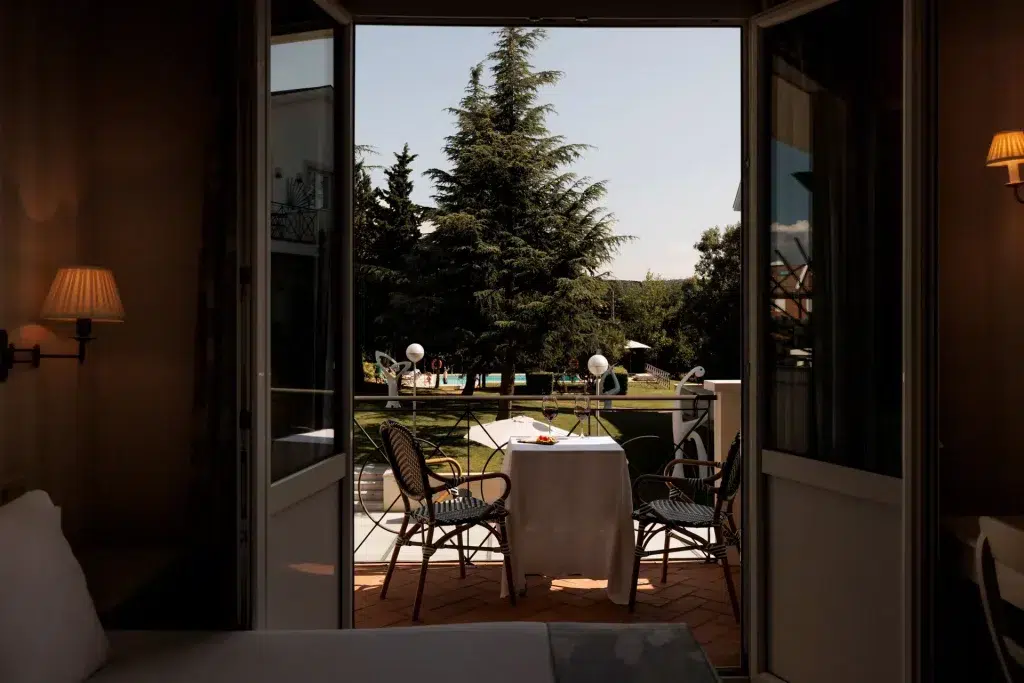
The municipality’s artisan cheese production is another culinary highlight, alongside traditional produce markets. The hotel’s breakfast is served in the manor house’s interior courtyard and relies on local produce.
Getting there and practical stay information
- By car, access is via the A-66, exit 30 towards Pravia, continuing to Plaza María Cristina. From Asturias Airport, it’s a 13-kilometre journey.
- By train, the connection runs via Oviedo, with a direct bus to Pravia stopping three minutes’ walk from the hotel.
- Parking is available via municipal areas and a covered car park 400 metres away, on Avenida de Prahúa.
- Check-in runs from 5:00 pm to 8:00 pm and check-out is until 12:00 pm. Late check-out can be extended until 4:00 pm subject to availability, at a cost of €15 per hour. Arrivals outside normal hours should be notified by phone.
Frequently asked questions about PAX Casona del Busto: a charming hotel in Pravia
Which hotels in Asturias have real history?
PAX Casona del Busto is a 16th-century palatial manor house in Pravia that retains visible original features: a 16th-century rope-and-mortar partition on the main floor, 19th-century skirting tiles, and peacock-blue woodwork typical of 18th-century Asturian manor houses.
What century is Casona del Busto from?
Casona del Busto is a 16th-century noble building. It underwent a thorough restoration to open as a hotel in 1993, preserving the original structure and construction features of the property.
Is it worth staying in a 16th-century building?
It depends on what you’re looking for. A historic building offers unique rooms, a courtyard and original features that a newly built hotel can’t reproduce. On the other hand, room size and layout vary: the deluxe room is the one located in the historic main building.
What can you visit near Pravia?
Near Pravia you can visit the pre-Romanesque church of Santianes (4 km), Somao and its indiano architecture (8 km), Playa de Aguilar (15 km), and Cudillero, Avilés and Oviedo, all less than 30 minutes away by car.
How many rooms does the charming hotel in Pravia have?
The hotel has 30 rooms across five room types: double (18 m²), deluxe (21 m²), superior family (32 m²), family (38 m²) and junior suite (36 m²). Twelve are arranged around the manor house’s interior courtyard.
How far is Asturias Airport?
Asturias Airport is 13 kilometres from the hotel. Access by car is via the A-66, exit 30 towards Pravia, to Plaza María Cristina.
Are pets allowed?
No. The hotel does not allow pets on its premises, in order to guarantee the comfort of all guests.
Is there parking at the hotel?
The hotel doesn’t have its own car park, but there are municipal parking areas nearby and a covered car park 400 metres away, on Avenida de Prahúa.
What are the check-in and check-out times?
Check-in runs from 5:00 pm to 8:00 pm and check-out is until 12:00 pm. Late check-out can be extended until 4:00 pm subject to availability, at a cost of €15 per hour.
Can weddings and events be held at the manor house?
Yes. The hotel has a meeting room, an event organisation service, a junior suite for wedding nights, and special rates for wedding and celebration guests, plus group booking management.
A charming hotel in Pravia where the court of the Kingdom of Asturias once stood
Within a four-kilometre radius, Pravia holds the oldest pre-Romanesque monument in Asturias and a historic ensemble declared a Site of Cultural Interest, and at its centre, a 16th-century palatial manor house turned into a charming hotel in Pravia. It’s a combination that’s hard to find at this scale anywhere in northern Spain. Check availability and room types on our official PAX Casona del Busto page, or get in touch with the hotel team through the contact form for group stays, weddings and events. We look forward to welcoming you!